

Dear fellow travellers,
I have been thinking about a person I used to know.
She believed in the goodness of people. In true love. In fairness. In the idea that there was always the one — not as a romantic cliché, but as a genuine cosmological conviction. She held these beliefs even as she publicly reclaimed them as too good for the real world, too naive, too soft. Even as she performed cynicism about them. She believed them anyway. That was her particular contradiction: the ironic distance and the total sincerity, existing at the same time.
She believed in herself. She believed she was worthy. She believed her imperfections were her charm rather than her liability.
She was kind but cold. Naive but arrogant. Fair in the way that people are fair when they have not yet learned how much fairness costs. She loved yellow. She loved her own faults and failures with a tenderness she couldn’t always extend to other things.
I knew her well.
She used to be mine.
She was me.
She is gone.
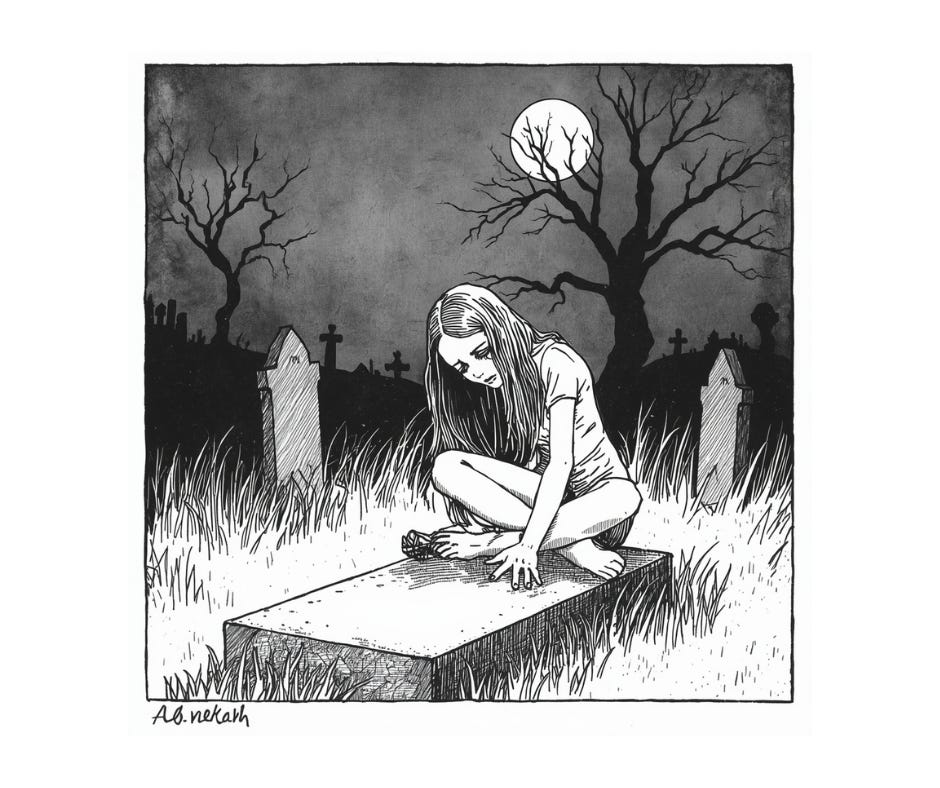
I have been trying to find the right word for what this is. Grief comes closest, but grief implies something external — a loss that happened to you, a person or place that left. What I am experiencing is something stranger. I am mourning myself. Standing at the edge of my own grave, reading an inscription I didn’t write, recognising the name.
People say that the self is not fixed — that we are always changing, always becoming. I know this. I have read enough to know this. But there is a difference between gradual becoming and the abrupt discovery that someone has been in your house, rearranging the furniture, and you only notice when you try to sit down and find the chair is gone.
I was informed. That is the word I keep returning to. Through therapy, through the breakdown, through the aftermath — I was informed about myself. About my patterns, my diagnosis, the architecture of my interior. I know more about how I work than I ever have before.
Being informed does not return what you lost.
I thought it would. I thought that understanding would be a kind of restoration — that naming the thing would give it back to me, clarified and intact. Instead, what I have is a more detailed map of a territory that has already changed. I know the old landscape intimately. I am standing in a new one, holding a map that no longer matches the ground.
I have to start again. Not from the beginning — I am not twenty-two, I do not have that particular luxury. But something like Suin 101. A new semester. A different curriculum. This version has a different interior, different outer features. When I place my hand against the wall she has built for herself, I feel the scars and dents in the concrete. She has been through things. She is not smooth.
There is less of her, somehow. Quieter. In black.
Some people, when I describe this, say: but this is growth. This is your growing sprout. This is what transformation looks like from the inside.
I know they mean well.
I didn’t want it this way.
I wanted to grow, yes. I have always wanted to grow. But I wanted the greenhouse — the careful, tended kind of growth, with the right conditions and enough light and someone occasionally checking whether the soil was too dry. I did not want to be stomped upon and told that the stomping was necessary, that pressure produces diamonds, that what doesn’t kill you et cetera et cetera.
The people who say these things have usually not been stomped upon recently. Or they have, and they have found a way to make meaning of it that I have not yet located. I am trying to locate it. I am not there yet.
What I am left with is a rage I do not know what to do with.
For a long time, it was castrated — contained, turned inward, converted into the quieter forms: guilt, self-blame, the relentless internal audit. That is the familiar direction. That is the well-worn path.
But something has shifted, here in the stillness of this period of rest, and the rage is coming back to me in its original form. Undirected. Unnamed. There are nights when I surface from sleep with a word on my tongue that I will not repeat here — simple, one syllable, absolute — and I do not know, even as I say it, who I am addressing.
Myself. The person I was. The circumstances that shaped me. The people who participated in the shaping.
All of the above. None of the above. I am still working it out.
Here is what kills me, and I want to be precise about this: I miss her. The old self. The one who believed in goodness and true love and her own worthiness without having to argue herself into it every morning.
And I hate her. For the naivety. For the certainty. For the way she walked into things with her eyes slightly closed because the full light was too much.
And I want to destroy whoever murdered her.
These three things exist at the same time, every day. Missing and hating and wanting justice, all aimed at overlapping targets, none of it resolving into anything clean.
This is, I think, what grief actually looks like when the loss is internal. It is not a straight line. It is not a sequence of stages that arrives somewhere useful. It is this: simultaneous, contradictory, exhausting.
I continue with my life. Time passes.
I am told this is how it works. I am told the new self, the one with the scarred walls and the unfamiliar interior, becomes livable eventually. Becomes, in time, beloved.
I am taking that on faith.
I have to believe in something.
Emotionally yours (in mourning, but present),
Suinny
From home, where the quiet is different from the temple quiet — softer, and harder in different places
P.S. — If you have ever stood at the grave of a previous version of yourself and not known whether to grieve or feel relief: I see you. Reply to this letter. We can be confused together.
P.P.S. — I know lots of you were waiting for the series to be returned. The letters are completed. They are ready to be released. Just you wait.