

Members of the jury,
Before we begin, I would like to enter my plea.
I plead not guilty.
Before the case begins, I want to say something about why I wrote it down at all.
Some people told me to let it go. To discard the memories, the emotions, and what had been done to me. They said I was being held by the past; that reflecting on the time inside the system kept me inside it. That the healthy thing was to turn my back, decide it wasn’t me anymore, and walk forward without the weight of it.
They were not wrong that the weight is real.
But I had spent seventeen months being told what to do with my own thoughts and emotions. What to feel, what to suppress, what to offer up, what to keep quiet. Someone else’s hand on the dial of my inner life — what was allowed to register, what needed to be explained away, what had to be converted into something more acceptable before it could exist.
I decided to write.
Not because I wanted to stay inside it. Because I know what happens when you put things in a closet. They don’t disappear. They rot. And eventually you have a different problem — something living in the dark, feeding on what you refused to name.
So this is the record. Not everything I felt, but everything I can name clearly and honestly. Not performance of healing, not a demonstration of how far I’ve come. Just: this is what happened. This is what it was like inside it. This is what I understand now that I didn’t understand then.
I am still understanding.
There is also a second reason I wrote it, which is smaller and more specific, and I want to name it honestly.
I wrote it for the people still inside. Not inside this particular shaman’s room — though for them too. But inside any system that has told them what their own feelings mean, what their nature is, what they deserve. The systems that use your real flaws to build a false verdict. The ones that know just enough about you to sound credible.
I know what it is like to be inside that and not be able to see the walls. I know what it is like to believe the verdict because it was delivered by someone who had watched you carefully. I know the particular confusion of a system that feels like understanding because it names you accurately in some places.
This is the record of how I got out.
It happened five months after the breakup.
I was still at the temple — and not in the healing, enlightened way I may have implied in my earlier letters. I was there writing unsent letters at any moment the time was given, performing 108 prostrations before dawn, and earlier in those months, genuinely planning a PowerPoint presentation to show her I’d changed enough to be worth taking back. The original title was more honest than the polished version I later came up with.
Why Should You Keep Suin?
Not a relaunch. A retention argument. I was preparing the case against my own disposal.
I had published twenty-five posts from the temple during those months. I wrote them in real time, from inside the brainwashing, believing everything the system had told me about what had happened. The early ones were the brainwashing at its most complete. I wrote that her clear goodbye was a gift. I wrote that I was grateful for the clean break. I also wrote: I still want to be Venus orbiting your sun. Not as a romantic metaphor. As a description of what the system had made me into — not a person with her own gravity, but an orbit. Something that exists only in relation to another body.
One post astonishes me most, looking back. I wrote it from a café at Seoul Express Bus Terminal, still inside the brainwashing, still framing the breakup as 시절인연 — the natural end of shared time, the clock running out. I hadn’t yet understood that I wasn’t a station at the end of a completed journey. I had been expelled at 3 am with a clutch and a fever while a dead grandmother assured my ex that the disposal was in hand.
And yet — underneath the wrong framework — I found something true.
I’m not luggage left on a platform. I’m the platform itself.
The nun who named the cult in January didn’t create that understanding. She completed it. The platform was already being built in that café, still inside the brainwashing, with cold coffee and the sound of buses departing.
Five months of believing I was crazy, fake, possessed, selfish, and fundamentally unlovable. Five months of believing that two people had done their absolute best to help a broken person — and that the broken person had failed them despite everything.
I was not the victim of this story. I was the villain. I was certain of this.
And then a Buddhist nun said four words that shattered everything.
The Question
I’d arrived at the temple on the 28th of August — our third anniversary, the day after the breakup. Three years to the day, I walked into a temple thinking I was going there to… heal.
A nun approached me one day. She said something about selfishness — that I took what was mine first before considering others. She said it plainly. Not as cruelty. Just as she saw.
And I heard it and agreed immediately.
Yes. Finally. Someone who sees it.
I had been told I was selfish for so long that it had become one of the core charges in the case against myself. One of the things I had agreed to, the way I had agreed to hollow gangjeong and champagne tongue and too greedy and too much. It felt true because it echoed something I already believed. And here was someone outside the system entirely arriving at the same conclusion independently.
So I didn’t push back. I asked her how to fix it.
I told her it wasn’t the first time someone had called me selfish. I explained why I was selfish — the history, the evidence, the case I had been building against myself for five months, and the one I had been helped to build for seventeen months before that. I offered it all up, still entirely inside the verdict, defending the charge even as I described it.
She didn’t engage with the selfishness at all.
She asked: “Why do you want to become a Buddhist nun?”
I told her the truth: “Because I might be happy here. And someone I loved believed so too.”
She was quiet for a moment. Then she asked me to tell her what happened.
So I did. For the first time since the breakup, I told someone the whole story. The shamanic ceremonies. The exorcisms. The accusations of being possessed. The final call where my ex told me to become a nun because I was too greedy.
I told her everything.
And when I finished, she looked at me and said — matter-of-factly, the way you’d tell someone they had spinach in their teeth:
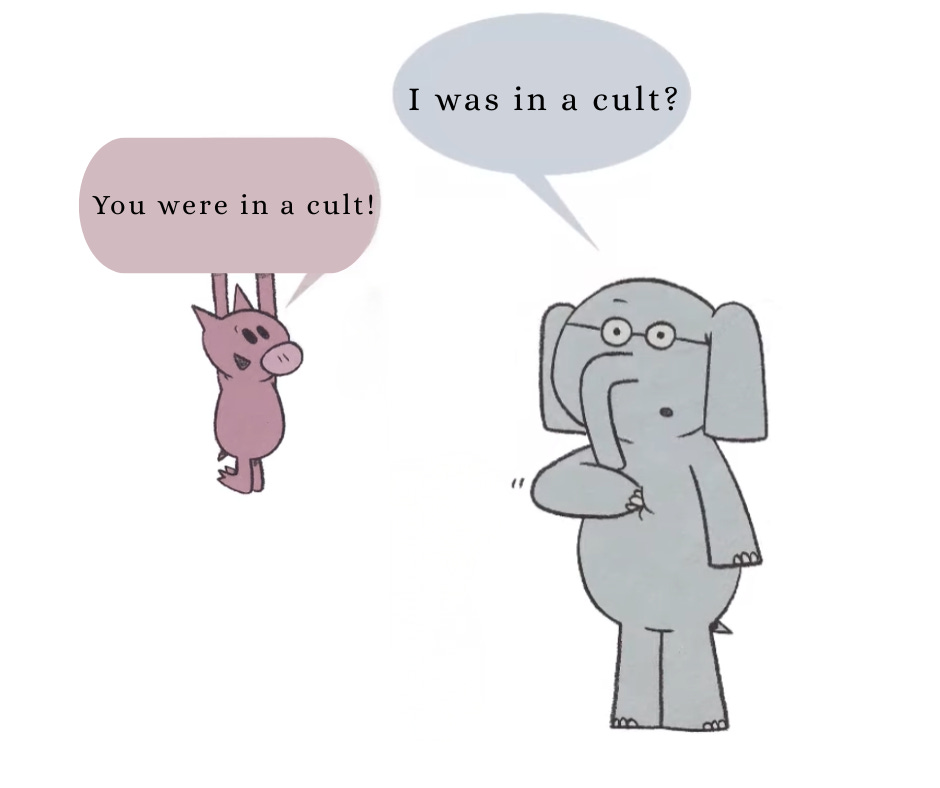
“You were deceived. This person used you and manipulated you. You were in a cult.”
My First Reaction
My first reaction was not relief.
My first reaction was: she’s wrong.
Because if she was right — if I had been manipulated, if I had been the target rather than the problem — then everything I had spent five months believing about myself was wrong too.
I had spent five months believing I was the bad guy. Not in an abstract, self-pitying way. I mean, I genuinely held my ex and the shaman as people with the moral high ground. They had tried so hard to help me. They had invested in me — money, time, ceremonies, energy — and I had kept failing them. I was the one who was broken. I was the one whose bad qualities “could not be borne.”
If the nun was right, that entire structure collapsed.
And some part of me wasn’t ready for it to collapse. Because, as painful as it was to be the villain, at least I understood that story. At least I had a role.
I also thought: I must have fallen into self-pity mode. That is why she is being kind to me. The system had already prepared me for this moment. When someone from outside says it sounds wrong, you already know what that means: they don’t understand the dynamics. They can’t see what you can see from here.
Every outside voice — even the ones saying you were not the problem — got filtered through the same mechanism. The system pre-answered compassion the same way it pre-answered criticism. Both arrived already interpreted. Both neutralised before they could land.
The only voice that eventually got through was my own — written down, accumulated, read back to myself until the shape of what happened became undeniable in my own testimony.
The Question I Couldn’t Answer
After the nun said “you were in a cult,” she asked me something I still can’t fully answer:
“Can you trust your own mind?”
I didn’t know.
For five months, I’d been one of five voices telling myself I was crazy. The shaman said I was possessed. My ex said I was fake. Her sisters said I was the problem. And I agreed with all of them — enthusiastically, gratefully. I thought their criticism was the most honest love anyone had ever shown me.
When five people tell you you’re crazy, and you’re one of the five — how do you start trusting yourself again?
The nun saw something I couldn’t see from inside it.
“They weren’t five separate people arriving at the same conclusion,” she said. “They were one voice — the shaman’s — repeated through five mouths. Including yours.”
I didn’t say anything.
She looked at me for a moment. Then she said:
“We shouldn’t even be talking about this as if it were just an experience. I want to take you to court and file a lawsuit. I’ve seen this. In a Netflix documentary.”
A Buddhist nun in a Korean mountain temple. Recognising it from a screen.
That was when the structure began, very slowly, to crack.
From a temple where I’m learning that being the villain of your own story is still a story someone else wrote,
Emotionally yours (and learning to trust myself),
Suinny
P.S. If you’ve ever been the bad guy in a story that you were also the most hurt by — you’re not alone in that. And the question “can I trust my own mind?” isn’t a weakness. It’s the first step toward trusting yourself again.
Next week: How the shaman found me — and why I was the one who opened the door.
One thing I’m curious about: Have you ever believed you were the villain in a story that hurt you the most?
I’m starting to realise how common that pattern might be.