

Dear fellow travellers,
I need to confess something that’s been eating me alive:
I no longer constantly think about her. But I constantly think I’m a failure.
The obsessive thoughts about her—what she’s doing, if she misses me, replaying our conversations—those have faded. They still pop up, sudden and intrusive, like advertisements I can’t close on a website. But they’re not constant anymore.
What’s constant now is the voice that says: “You failed. You’re not normal. You’re not healthy. You’re broken. And that’s why she left.”
I thought I’d feel relief when I stopped thinking about her every moment. And there is relief—my brain has some space back.
But that space got immediately filled with something worse: relentless, crushing self-judgment.
And I’m so tired. Not of missing her anymore. Of hating myself for losing her.
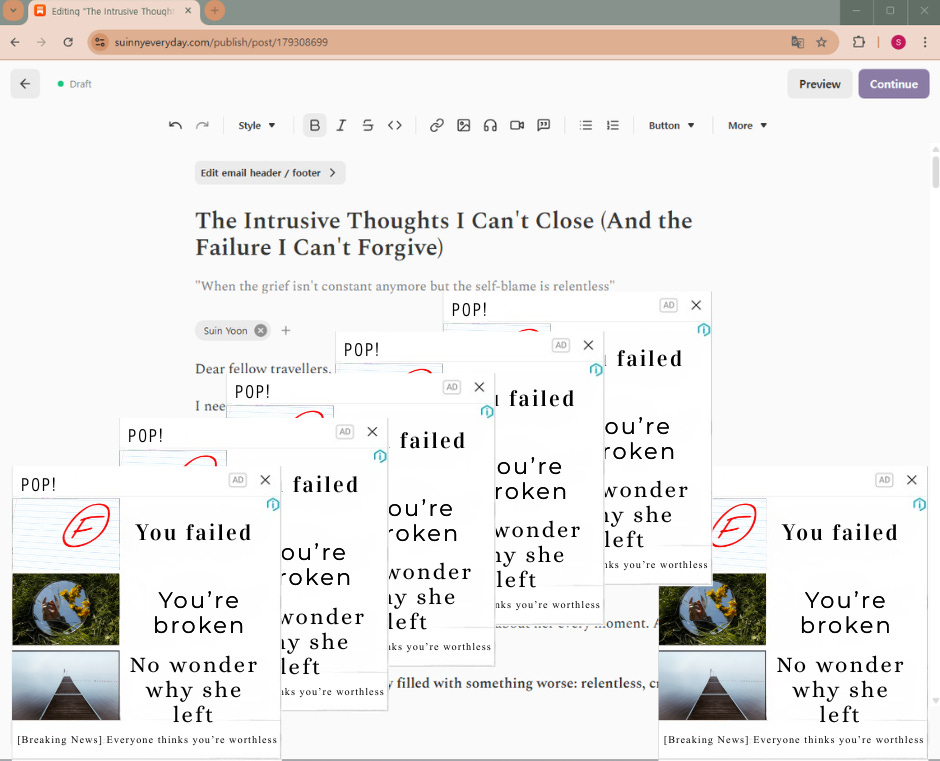
The Pop-Up Thoughts I Can’t Block
She doesn’t occupy my mind constantly now. But she appears in flashes. Intrusive. Unexpected. Like pop-up advertisements I never asked for and can’t permanently close.
I’m working. Focused. Present. And suddenly: flash of her face.
I’m eating dinner. Calm. And suddenly: memory of something she said.
I’m walking to evening prayers. Mind clear. And suddenly: wondering what she’s doing right now.
These thoughts aren’t a constant occupation anymore. They’re intrusions. Pop-ups that appear without warning, disrupt whatever I’m doing, and then disappear—leaving behind a residue of pain I have to shake off.
I can’t predict them. Can’t prevent them. Can’t permanently block them.
They just appear. Random. Unwanted. Like my brain is a website with malware I can’t fully remove.
And every time one pops up, it’s not just “I miss her.” It’s: “You failed. You lost her. You weren’t good enough. You’re still not good enough.”
What’s Actually Eating Me Alive
Here’s what I’ve realised: the thoughts about her aren’t the real problem anymore.
The real problem is what those thoughts trigger: the overwhelming belief that I’m a failure.
Every pop-up thought about her becomes evidence:
Flash of her face → “You failed her.”
Memory of her voice → “You weren’t enough.”
Wondering what she’s doing → “She’s happier without you because you’re a failure.”
Seeing something she would have liked → “You failed to keep someone who saw beauty in the world with you.”
The thought of her is just the trigger. The real wound is the belief that I’m fundamentally broken, fundamentally not enough, fundamentally a failure.
And that belief doesn’t just pop up. It’s there all the time. Underneath everything.
The Failure Narrative I Can’t Escape
Here’s the story my brain tells me on repeat:
“She left because you’re a failure.”
Not because you were incompatible. Not because the timing was wrong. Not because relationships sometimes end even when people love each other.
She left because you failed. As a partner. As a person. As someone worthy of being chosen.
And the evidence is everywhere:
You have BPD. Failure to have a “normal” brain.
You were too intense. Failure to be easy to love.
You needed too much. Failure to be self-sufficient.
You exhausted her. Failure to not be a burden.
You’re still not okay. Failure to bounce back. Failure to heal at an acceptable pace. Failure to be resilient.
You’re still processing this breakup months later. Failure to let go. Failure to move on. Failure to be “over it” by now.
You’re still angry at yourself. Failure to forgive yourself. Failure to practice self-compassion. Failure at the very healing you’re supposed to be doing.
The proof of your failure is that she’s gone and you’re still here, broken.
And I can’t escape this narrative. It colours everything.
Not in a “Normal Healthy” Mental State
One of the things that crushes me most: I’m not bouncing back the way “normal” people do.
Normal people have a breakup. They’re sad for a while. They process. They heal. They move on. They get back to baseline.
I’m not at baseline. I don’t know if I have a baseline.
With BPD, my baseline is already unstable. My sense of self is already fragile. My emotional regulation is already compromised.
So when a relationship ends—especially one where I made someone my entire anchor—I don’t just bounce back. I fracture.
And then I judge myself for fracturing. For not being resilient. For not healing faster. For not being “normal” about this.
I see other people go through breakups and within a few months they’re fine. Dating again. Happy. Whole.
And here I am, months later, still working at a temple because I can’t trust myself to function in the regular world yet.
Still needing structure because my internal world is too chaotic. Still crying during prayers sometimes. Still having intrusive thoughts. Still angry at myself.
Failure to be normal. Failure to be healthy. Failure to bounce back.
The Past I Can’t Let Go Of
I know I’m supposed to let go. Everyone says it: “Let go. Move forward. You can’t change the past.”
But I can’t let go. Because the past is proof of my failure.
If I let go of the past, I let go of the evidence. And if I let go of the evidence, what do I replace it with?
Right now, the narrative is: “I failed. The proof is in the past. If I just analyse it enough, maybe I can understand exactly where I failed and fix it for next time.”
But if I let go of analysing the past, then what? Then I’m just... a person who failed, with no understanding of why, no way to prevent it from happening again.
The past holds all the data. All the moments I could have done better. All the mistakes I made. All the proof that I’m a failure.
How do you let go of that? How do you stop analysing when every memory is evidence that you weren’t enough?
I’m stuck in the past because the past is the only place where I can try to make sense of why I failed. And if I stop trying to make sense of it, then I’m just... broken, with no explanation, no fix, no hope of doing better next time.
I can’t let go because letting go feels like accepting that I’m just fundamentally not enough, and there’s nothing I can do about it.
The Anger I Turn Inward
Here’s what’s really eating me up: I’m so angry at myself.
Angry for every mistake. Angry for not being better. Angry for having BPD. Angry for being too much. Angry for not seeing this coming. Angry for not fighting harder. Angry for not being someone she could keep choosing.
And I know I’m supposed to forgive myself. I’m trying. I’m really trying.
The monks talk about self-compassion. My therapist talks about self-forgiveness. Every healing resource says: “Be gentle with yourself. You did the best you could.”
But I don’t believe it. I don’t believe I did the best I could. I believe I failed, and I’m angry at myself for failing.
And then I’m angry at myself for being angry at myself. Failure to even practice the self-compassion I know I need.
It’s a loop: failure → anger → more failure → more anger.
And I don’t know how to break it.
The Belief That I’m Letting Everyone Down
It’s not just her. I feel like I’m letting everyone down.
The monks who are trying to help me heal. I’m still broken. Still struggling. Still crying. Failure to heal at the pace they expect.
My friends who I’m letting down because I’m too depressed to function at full capacity. Cancelling every promise and schedule that I promised I’d attend. Failure to be reliable.
My family who don’t understand why I’m still not okay. Who ask when or if I’m coming home. Who want me to “live like a normal person.” Failure to be the person they remember.
Myself. The person I thought I was. The person I want to be. Failure to become whole. Failure to be enough. Feels like I don’t even know myself anymore.
And her. Even though she’s gone. Even though it’s over. I feel like I’m still letting her down by not being okay yet. By not having learned from this. By not being better.
Everyone is disappointed in me because I’m a failure. And I’m most disappointed in myself.
What I Know vs. What I Believe
I’ve read the books. I know the counter-narratives. I can recite them to myself like mantras:
“You’re not failing. You’re measuring yourself against an impossible standard and punishing yourself for not meeting it.”
I know this. I’ve read it in every self-help book, every BPD resource, every article on self-compassion.
“She left because she chose to. Not because you failed some cosmic test. She made a choice based on what she needed. That’s not evidence of your failure.”
I know this too. I understand it intellectually. I can explain it to others.
“Having BPD isn’t a moral failure. It’s a brain that works differently. Some people can hold that. Some people can’t. Neither answer makes you a failure.”
Yes. I’ve highlighted this passage in three different books. I’ve journaled about it. I understand the logic.
“You’re not broken. You’re healing. And healing isn’t linear. It doesn’t follow timelines. You’re exactly where you need to be in your process.”
I know. I KNOW. I can tell myself this. I have told myself this. Repeatedly.
But here’s the problem: I don’t believe any of it.
Deep down, underneath all the books and the therapy language and the rational counter-arguments, there’s a voice that’s been there my whole life—the one that BPD amplifies to deafening levels—and it says:
“These are just nice words. People say them because they’re supposed to. They don’t know your true ugliness. They don’t see what you really are. If they did, they’d know: you’re a failure, and they’ll leave like she did. And no amount of self-help books will change that truth.”
The Standard I’m Measuring Myself Against
Here’s what I’m realising: I’m measuring myself against an impossible standard and then using my failure to meet it as proof that I’m fundamentally not enough.
The standard is:
Be mentally healthy (I have BPD)
Don’t be too much (my baseline is intense)
Heal quickly (I’m healing slowly)
Don’t need support (I need a lot of support)
Bounce back easily (I fractured)
Let go of the past (I’m still processing)
Forgive yourself (I’m still angry)
Be enough to keep someone (she still left)
I can’t meet that standard. Nobody could. But I keep trying, and keep failing, and keep using that failure as proof that I’m broken.
What if the problem isn’t that I’m a failure? What if the problem is that the standard itself is impossible?
The Practice of Self-Forgiveness (That I’m Failing At)
I’m trying to forgive myself. I really am.
Every morning I sit with the intention: “Today I will be gentler with myself. Today I will practice self-compassion.”
And every day, within hours, I’m right back to: “You failed. You’re not enough. You’re letting everyone down.”
The monk taught me a practice: When the failure thought comes, meet it with: “I’m doing the best I can with what I have right now.”
But my brain immediately argues: “No you’re not. You could do better. You’re just not trying hard enough.”
How do you forgive yourself when you genuinely believe you failed? When the evidence seems so clear? When the person you love left because you weren’t enough?
I don’t know. I’m still trying to figure it out.
The Pop-Up I Can’t Permanently Close
Here’s what actually happens now:
I’ll be working. Focused. Present. And a thought pops up: her face, her voice, a memory.
And immediately behind it: “You failed her.”
I notice it. I try the monk’s teaching: “I’m doing the best I can.”
The thought closes. Like an ad I finally X out of.
But it pops up again later. Different memory. Same message: “Failure.”
And again. And again. And again.
I can close each individual pop-up. But I can’t stop them from appearing. And I can’t remove the malware—the core belief that I’m a failure—that keeps generating them.
So I keep closing them. One at a time. Notice, redirect. Notice, redirect.
Thought: “She’s happier without you.”
Response: “I’m doing the best I can.”
Close.
Thought: “You’re broken and always will be.”
Response: “I’m healing. It’s not linear.”
Close.
Thought: “You’re letting everyone down.”
Response: “I’m showing up. That’s enough for today.”
Close.
Close, close, close. All day. Every day.
What I Actually Need a Break From
I don’t need a break from missing her anymore. The missing is manageable now.
I need a break from hating myself.
I need a break from the voice that says I’m a failure.
I need a break from measuring myself against impossible standards.
I need a break from the anger I turn inward.
I need a break from believing that everyone is disappointed in me.
I need a break from the exhausting work of trying to forgive myself for being human.
But I don’t know how to take that break. Because the voice doesn’t stop. The pop-ups don’t stop. The self-judgment doesn’t stop.
So I just keep closing them. One at a time. Notice, redirect. Notice, meet with compassion. Notice, try to forgive.
Thousands of times a day.
Hoping that eventually, maybe, the malware will weaken. The pop-ups will slow. The voice will be quiet.
But right now? Right now I’m just tired. Not of missing her. Of failing myself over and over in my own mind.
For Anyone Else Fighting the Failure Narrative
If you’re reading this because you also believe you’re a failure, I want to tell you something I don’t yet believe myself:
You’re not a failure. You’re measuring yourself against an impossible standard.
Having a mental health condition isn’t a failure. Being “too much” for one person isn’t a failure. Healing slowly isn’t a failure. Needing support isn’t a failure. Still processing pain months later isn’t a failure.
None of that is a failure. That’s just being human.
The pop-up thoughts will come. The self-judgment will come. The anger will come.
Notice it. Meet it with compassion if you can. And keep going anyway.
You’re not failing. You’re healing. And healing doesn’t follow timelines or look “normal” or happen on anyone else’s schedule.
You’re doing the best you can with what you have right now. And that has to be enough.
Even when the voice says it isn’t. Even when the pop-ups keep appearing. Even when you can’t forgive yourself yet.
Keep closing the pop-ups. Keep trying. Keep showing up.
You’re not a failure. You’re just human. And being human is hard enough without adding self-hatred to the weight.
The View From Here
I’m writing this after evening prayers, sitting in my room at the temple.
A thought just popped up: her laughing at something I said. And immediately: “You failed to keep that joy in your life.”
Notice. “I’m doing the best I can.” Close.
Another will pop up soon. Maybe in five minutes. Maybe in five seconds.
And I’ll close it again. And again. And again.
Not because I’m healed. Not because I’ve forgiven myself. Not because I believe I’m not a failure yet.
But because that’s all I can do right now. Keep closing the pop-ups. Keep trying to meet myself with compassion. Keep showing up even when I believe I’m letting everyone down.
The malware is still there. The core belief that I’m a failure. I don’t know how to remove it yet.
But I’m learning to manage the pop-ups. One at a time. Notice, compassion, close. Notice, compassion, close.
It’s exhausting. But it’s better than constant self-hatred. It’s progress, even if it doesn’t feel like enough.
And maybe someday I’ll actually believe: I’m not a failure. I’m just human. And that’s enough.
But today? Today I’m just closing pop-ups. And trying to survive the voice that says I’m not enough.
One intrusive thought at a time.
These letters from the temple are how I’m learning that the hardest person to forgive is yourself—and sometimes healing means just closing the self-hatred pop-ups one at a time until they eventually slow down.
Next week: Still figuring out what needs to be written
Still trying (even when I believe I’m failing),
Suinny
If you’re struggling with self-blame and feeling like a failure:
Crisis Text Line: Text HOME to 741741
National Suicide Prevention Lifeline: 988
BPD-specific therapy: behavioraltech.org (DBT)
Self-compassion resources: self-compassion.org
You’re not a failure. You’re measuring yourself against impossible standards. Having BPD isn’t a failure. Healing slowly isn’t a failure. Still processing pain isn’t a failure. You’re doing the best you can. And that’s enough. Even when the voice says it isn’t.