
The One Who Is Satisfied Is Happy.
On chasing happiness, giving up, and what I found when I stopped

Dear fellow travellers,
For a long time, I was obsessed with the word happy.
Not in the way people are casually obsessed with it — posting about it, performing it, optimising their mornings around it. I mean something more desperate than that. I mean I would arrive at moments that looked, from the outside, exactly like happiness — the right setting, the right company, the right conditions — and feel nothing land. A kind of hollow where the feeling was supposed to be. And then, quietly, the panic that this was evidence of something wrong with me. That I had missed something essential. That other people were receiving something I wasn't.
I began to wonder whether I had simply never learned what happiness felt like. Whether I had been handed the concept without the experience, and had been chasing a word rather than a thing.
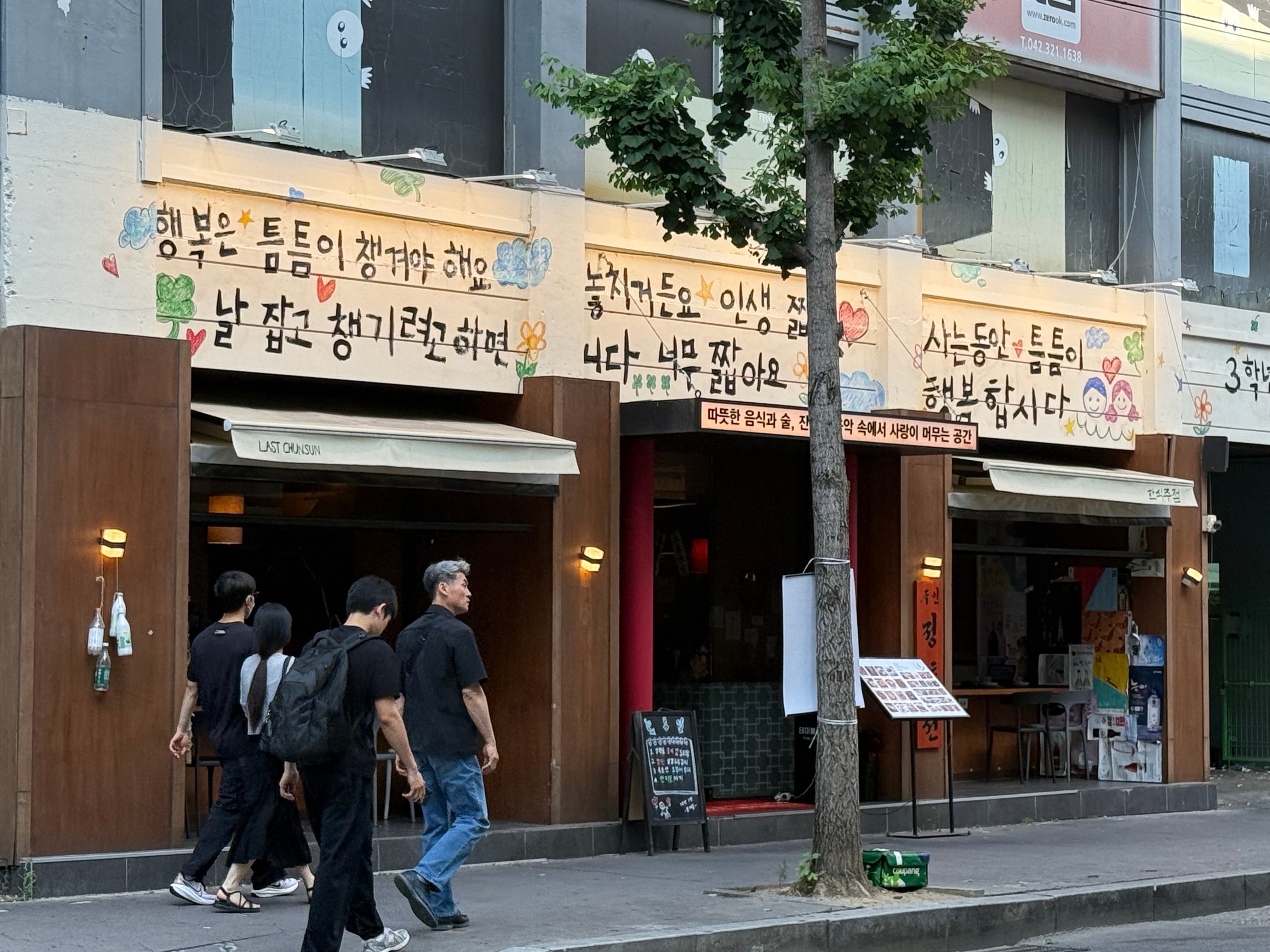
Buddhism has a teaching about this. Several, actually, but the one that kept surfacing in my months at the temple was about dukkha — the suffering that is woven into the fabric of wanting. The teaching goes something like this: happiness and pain are not opposites. They are companions. When you grasp at happiness, you guarantee the suffering of its loss. The release is not to find better happiness. The release is to let go of the grasping itself.
I heard this and, to be honest, I thought it was complete nonsense.
I am a human being with a dopamine system. I run toward pleasure and away from pain, the same as every other creature that has ever tried to survive anything. Telling me to release my attachment to happiness felt like telling me to release my attachment to breathing — technically a sentence, technically in English, not particularly useful.
I sat with my resistance to it for a while. That is, it turns out, the correct response. You are not supposed to accept it immediately. You are supposed to notice the resistance and stay there until something shifts.
Something shifted.
I cannot tell you exactly when. It wasn't a revelation — it never is, despite what the stories suggest. It was more like a very gradual loosening. A slow unclenching of something I hadn't known was held tight.
I stopped trying to locate happiness and started trying to locate the present moment. Not as a technique — I am suspicious of techniques, they have the quality of performing the thing rather than having it — but as a genuine experiment. What is actually here, right now, in this precise moment? The wind. The quality of light through a particular window at a particular hour. The sound of someone moving in another room. The temperature of the air on my forearms. The specific weight of the silence between sounds.
Not: is this enough?
Not: should I be feeling more?
Just: what is here?
And something about staying with that question — really staying, not using it as a warm-up for the next thought — began to change the texture of ordinary time. The moments stopped being intervals between the moments that mattered. They started being the thing itself.
I realised, slowly, that what I had been missing was not happiness. It was satisfaction. They are not the same word. Happiness implies a peak, an arrival, a feeling that announces itself. Satisfaction is quieter. It is the recognition that what is surrounding you is, right now, just enough. Not more than enough. Not a dream come true. Just: enough. And nothing needs to be added.
I told this to a Buddhist nun. She listened — she has a particular quality of listening, the kind that does not rush toward response — and then she said:
The one who is satisfied is happy. Then they go into the state of samadhi. Then they will get the enlightenment.
I sat with that for a long time.
She was not telling me that satisfaction leads to happiness as a reward. She was telling me that satisfaction *is happiness — that the thing I had been running toward was already present in the moment I stopped running. That samadhi, that state of deep stillness, is not an achievement separate from the ordinary. It is what the ordinary becomes when you are finally willing to be inside it.
I don't know if I believe in enlightenment. I am not sure I have the patience for it, or the sustained discipline, or the right relationship to desire. But I believed her in that moment. Something in the simplicity of it landed.
The one who is satisfied is happy.
Not the one who has achieved. Not the one who has healed, or recovered, or arrived somewhere better. The one who is satisfied — with the wind, the light, the shadow, the scent of whatever is blooming right now outside this window — that one is happy.
I have been practicing this. Imperfectly, inconsistently, with significant failures. There are days when the old desperation returns and I find myself grasping again, chasing the feeling I cannot locate, arriving at hollow moments and panicking.
But there are also mornings — more of them now — when I sit with whatever is in front of me and feel, quietly and without drama, that it is enough.
That is new. That is genuinely new.
I don't know what to call it except what the nun called it.
Happy.
Emotionally yours (quietly, for once),
Suinny
From home, where the light through the window is, this morning, enough
P.S. — If you have ever chased happiness into a moment that looked exactly right and felt nothing land: I think you were looking for satisfaction and didn't know the word for it yet. It's a different search. A quieter one. I hope you find it.