

Dear fellow travellers,
I need to tell you about Myanmar. About a pilgrimage that wasn’t supposed to be a pilgrimage. About a sceptic who found herself moved by something she doesn’t quite believe in.
I’m not a religious person. Never have been. I live at a Buddhist temple, yes, but I came here for structure, not spirituality. For survival, not salvation.
I’m sceptical. Cynical, even. I want to think positively, but my brain always jumps to: “What will go wrong? What bad thing is coming next?” I’m anxious. I doubt everything.
And yet.
Last week I went to Myanmar. Four nights, five days. It wasn’t a trip—it was work. I served the head monk on a pilgrimage program. And something happened there that I’m still trying to understand.
Something that moved me even though I don’t believe it should have.
This Wasn’t a Vacation (This Was Work)
Let me be clear: I didn’t go to Myanmar for spiritual awakening. I went because it was my job.
My role: serve the head monk. Make sure he’s comfortable. Anticipate his every need without being asked.
What that actually meant:
Food service: Ensuring his meals were appropriate. Filling his water cup before it was empty. Making sure the temperature was right, the portions correct, everything exactly as needed.
Logistics: Carrying his backpack and bags everywhere. Heavy bags. All day. Up the pagoda stairs. Through crowded temples. In the heat.
Anticipation: Taking things out of bags before he asked. Having items ready before he needed them. Reading his mind about what would be required next.
Ceremony preparation: Setting up for rituals. Making sure everything was in place. No mistakes allowed.
Interpretation: Translating for monks and laywomen who joined the pilgrimage. English, Korean, back and forth, constantly.
It was stressful. Every detail had to be perfect. The head monk needed to be pleased. One mistake could reflect badly on the temple, on me, on everything.
I wasn’t there to find myself. I was there to make sure the head monk’s water glass never got below half-full.
And yet. I loved that I got to see Myanmar.
The Contradiction of Serving While Witnessing
Here’s the strange thing about working a pilgrimage: you’re so focused on the work that the sacred moments catch you off-guard.
I’m carrying bags up hundreds of stairs to another pagoda. Exhausted. Sweating. Focused on not dropping anything. And suddenly I look up and there’s a golden Buddha sixty feet tall and my breath catches.
I’m preparing for a ceremony. Laying out offerings. Making sure incense is lit properly. Entirely focused on the task. And suddenly the monks start chanting and the sound fills the entire space and something in my chest tightens.
I’m standing next to the head monk, professional mode, just in case he needs me, and a laywoman is asking questions about her life. And suddenly I’m hearing the answer too and something about it lands differently than it ever has before.
You can be working and still be moved. You can be stressed about logistics and still experience wonder.
I didn’t expect that. I thought: either you’re working (practical, grounded, focused) or you’re experiencing spirituality (open, receptive, present).
But somehow Myanmar was both. Simultaneously. All the time.
Shwedagon Pagoda: When Gold Sounds Like a Fairy Tale
On our last day in Myanmar, we went to the Shwedagon Pagoda.
I’d seen pictures. I knew it was famous. I expected it to be impressive in the way tourist sites are impressive: “Wow, that’s big. That’s shiny. Okay, what’s next?”
I was not prepared for what it actually felt like.
The sound: Golden bells and charms in the wind. That specific sound—you know the one in animated movies when they show treasure? When gold coins spill and jewellery cascades? That exact sound. But real. Everywhere. Constant.
The feeling: Warm marble under bare feet. Not hot enough to burn, but warm enough that you feel it. Solid. Real. You’re walking on stone that thousands of people have walked on for hundreds of years and you can feel it.
The colours: Gold. Everywhere. Not just on the main pagoda—on everything. Statues, small pagodas, decorative elements. All gold. Catching the light. Reflecting moonlight. Almost too much. Almost overwhelming.
The smell: Incense so thick you could taste it. Not delicate temple incense—intense, heavy, everywhere.
The sound (again): Not just bells. Monks chanting. People praying. Murmured mantras. The constant low hum of devotion.
We had an evening ceremony there. Next to a Buddha made of jade. As the sun set and the moon rose, I walked through the complex looking up at the stars. And everything—the shiny pagodas, the Buddha statues, the wizard figures, the golden light, the chanting—all of it felt surreal.
Like I’d walked into a fairy tale. Like reality had shifted slightly to the left and I was in some in-between place where the physical and the mystical overlapped.
And I’m a sceptic. I don’t believe in mystical in-between places.
But I felt it anyway.
Three Months at a Temple and I Still Doubt Everything
Here’s what I need you to understand: I’ve been living at a Buddhist temple for three months. And I still doubt everything.
Three months is long if you think it’s long. Short if you think it’s short. Either way, it’s enough time to have done things the “original me” would never have done:
Dawn prayers at 4:30 AM. Every day. For months.
108 prostrations. Full-body bows. When I can manage them.
Meditation sessions. Sitting. Breathing. Trying to quiet my mind.
Evening prayers. Chanting in a language I barely understand.
Has it helped? Yes. Absolutely. The structure. The routine. The practice of showing up even when I don’t want to.
Do I believe in it? I... don’t know.
Do I doubt it? Constantly.
I doubt the teachings. I doubt the practices. I doubt whether any of this matters. I doubt my own doubts.
Even now, if you ask me: “Do you have no doubts about what you’re thinking, your questions, your opinions?”—the answer is: I doubt everything up until now.
I was told: “There’s no help in looking at the past. Live in the present.”
But sometimes the questions that come up lead me straight into worry and affliction anyway.
I want to believe. I want to trust. I want to just accept and move forward.
But my brain doesn’t work that way. It questions. It doubts. It picks apart every experience looking for evidence it means nothing.
And yet. Something happened at Shwedagon Pagoda that my doubting brain can’t fully explain away.
The Buddha I Wasn’t Looking For
The four nights and five days in Myanmar passed so quickly. Too quickly.
Standing at Shwedagon Pagoda on that last evening, I thought: I want to come back here as a free traveller. Spend all day meditating. Just sit and be present with whatever this feeling is.
I’ve been learning about Buddhism’s dependent origination. The law of karma and connections. How everything is interconnected. How people and moments come into your life for reasons.
I wanted to find my connection.
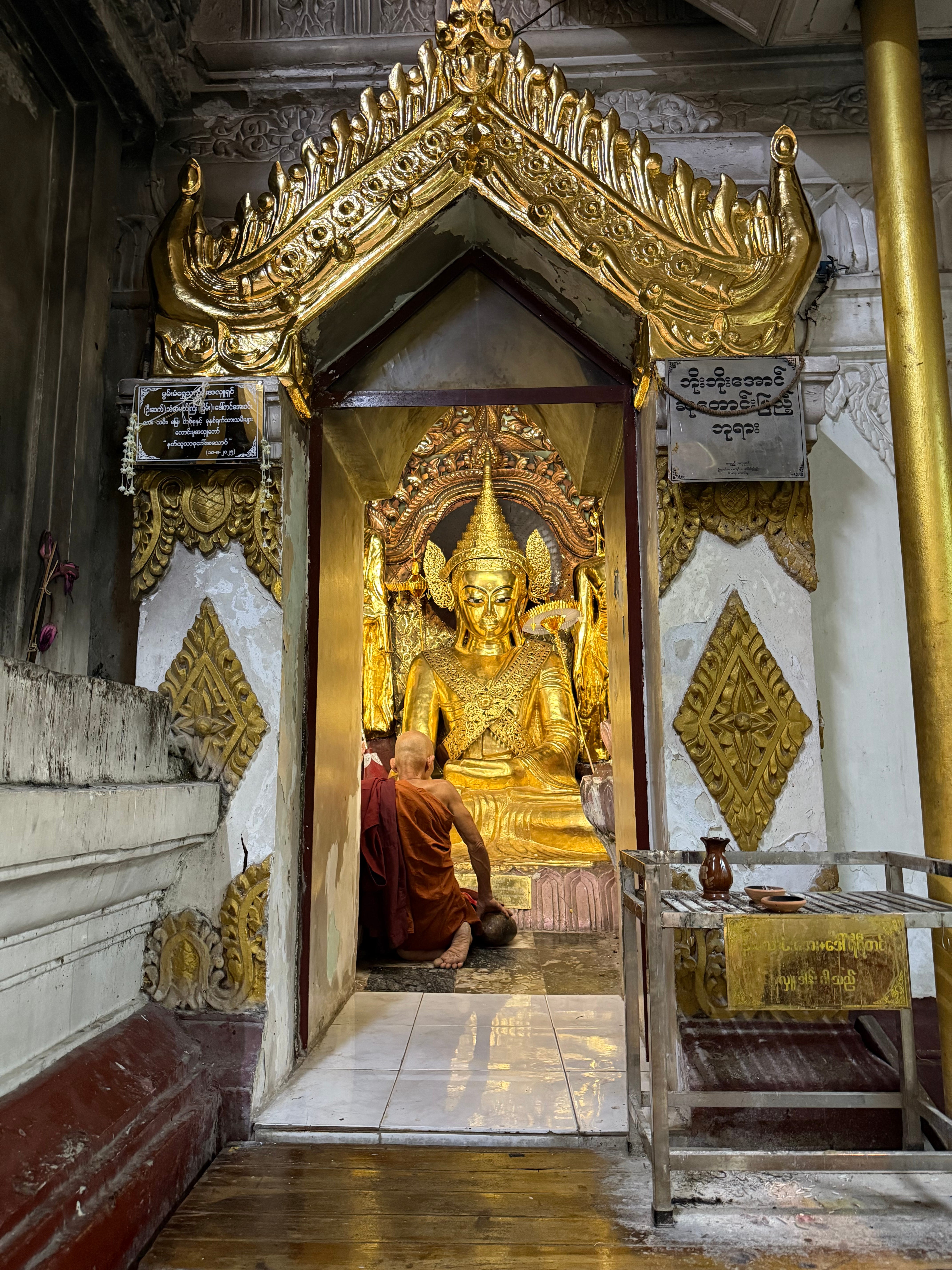
We had fifteen minutes before we needed to leave. I decided: I’m going to wander and find a Buddha statue that speaks to me. One that I feel drawn to. And I’ll pray there.
I walked through the complex. Looking. Waiting to feel... something. Some pull. Some sign.
And then a local person—a stranger—suddenly called me over.
He led me to a cave-like place. Sat me down in front of a large golden Buddha statue.
“This one is very efficacious for women,” he said.
I felt... something. Not a voice. Not a vision. Just a sense of: Yes. This is where I’m supposed to be right now.
So I sat. I closed my eyes. And I prayed.
I prayed even though I don’t know what I believe about prayer. I prayed even though my sceptical brain was saying: “This is just ritual. Just superstition. It doesn’t mean anything.”
I prayed anyway. For about ten minutes. And I made an offering—gave all my remaining kyat to the local man, who turned out to run a Buddhist school.
I was supposed to use that money the next day before flying out. But I didn’t need it. And maybe it could be useful somewhere else. Maybe that’s its own form of connection.
Later, I looked up the statue. Bo Bo Aung. A practitioner. The description said: prayers related to connections and karma are particularly well-answered here. The “prayer efficacy” is strong.
Of all the things I saw in Myanmar—Buddha’s genuine relics, historically significant temples, massive golden pagodas—that Bo Bo Aung statue is what stays with me most.
The one I wasn’t looking for. The one I was led to by a stranger. The one that somehow felt right even though I don’t fully believe in “feeling right” as a reliable guide.
The Gap Between Intellect and Experience
Here’s the tension I can’t resolve:
My intellect says: This was a coincidence. Pattern-seeking. Emotional vulnerability is making me read meaning into random events. The stranger probably directs lots of tourists to that statue. The “feeling” of connection was just exhaustion and overwhelm in a beautiful place.
My experience says: Something happened there. Something I can’t fully explain. A moment where I felt... aligned? Connected? Drawn to something larger?
My intellect says: You’re a sceptic. You doubt everything. Don’t abandon critical thinking just because something feels meaningful.
My experience says: But it did feel meaningful. And maybe meaning doesn’t require belief to be real.
I don’t know how to reconcile these.
I doubt the teachings. I doubt the practices. I doubt whether prayer “works” in any measurable way. I doubt whether karma and connections are real or just comforting stories we tell ourselves.
But I can’t doubt that I felt something in front of that Bo Bo Aung statue. That I was moved by the Shwedagon Pagoda in a way I didn’t expect. That Myanmar left something in me that I’m still processing.
Maybe you can doubt the metaphysics while still honouring the experience. Maybe you can be a sceptic and still be moved.
Maybe faith and doubt aren’t opposites. Maybe they’re just two ways of engaging with the same mystery.
What the Pilgrimage Taught the Sceptic
I went to Myanmar to work. To serve the head monk. To do my job correctly and not mess up.
What I got instead:
Permission to hold contradictions. You can doubt everything and still be moved. You can be sceptical and still pray. You can question the meaning while experiencing it.
The realisation that beauty matters even if it’s “just” beauty. Maybe the golden pagodas don’t connect to anything cosmic. Maybe they’re just beautiful. Maybe that’s enough.
Evidence that you can be led somewhere without understanding where you’re going. That stranger was directing me to Bo Bo Aung. I don’t know why. But I’m glad I followed.
Proof that experience transcends belief. I don’t have to believe in prayer efficacy to honour that I prayed. I don’t have to believe in karma to notice that moment felt significant.
The understanding that doubt doesn’t disqualify wonder. My sceptical brain didn’t prevent me from being awed by the Shwedagon Pagoda. The doubt and the wonder coexisted.
I’m still a sceptic. I still doubt everything. I still question whether any of this means what people say it means.
But I went to Myanmar as a cynic and came back... something slightly different. Not a believer. But maybe a sceptic who’s willing to be surprised.
For Anyone Else Who Doubts Everything
If you’re reading this because you also live in the tension between scepticism and spiritual experience:
You don’t have to resolve it.
You can doubt the teachings while appreciating the practice. You can question the metaphysics while honouring the experience. You can be critical and still be moved.
Scepticism isn’t the opposite of spirituality. It’s just a different way of engaging with it.
You’re allowed to:
Doubt everything and still pray sometimes
Question meaning while experiencing moments of connection
Be cynical about ritual while participating in it anyway
Not believe in karma while noticing patterns
Think it’s all superstition while still being moved by beauty
Your doubt doesn’t disqualify your experience. Your questions don’t invalidate your wonder.
Maybe the point isn’t to resolve the tension. Maybe the point is to live in it. To hold both. To doubt and to experience. To question and to be moved.
Maybe that’s what pilgrimage actually is: not finding answers, but learning to hold questions differently.
The View From Here
I’m back at the temple now. Back to my normal routine. Dawn prayers. Work. Evening prayers. Sleep. Repeat.
Myanmar feels like a dream. Did I really see the Shwedagon Pagoda that evening? Did I really sit in front of Bo Bo Aung and pray? Did any of it really happen?
But I have the memory. The warm marble under my feet. The sound of golden charms clashing. The feeling of being led to something I wasn’t looking for.
I still doubt everything. Still question. Still can’t tell you whether prayer works or karma is real or connections mean anything.
But I know I felt something. And I know I’m different for having felt it, even if I can’t explain how.
Maybe that’s enough. Maybe the sceptic’s pilgrimage isn’t about finding faith. It’s about finding room for mystery even in doubt.
And maybe—just maybe—that’s its own form of belief.
These letters from the temple are how I’m learning that you don’t have to stop being a sceptic to be moved by beauty—and sometimes the experiences you don’t seek are the ones that stay with you longest.
Next week: Still figuring out what needs to be written
Still doubting, still wondering, still here,
Suinny
For anyone else holding scepticism and spirituality in tension:
You’re not doing it wrong. The doubt is part of the practice. The questions are valid. You don’t have to choose between critical thinking and spiritual experience. You can hold both. The tension itself might be the point.
Resources for sceptical spiritual seekers:
“A Skeptic’s Path to Enlightenment” podcasts
Secular Buddhism podcasts
Stephen Batchelor’s work on Buddhism without beliefs
You don’t need faith to be moved. You don’t need belief to experience wonder. You just need to show up and let yourself be surprised.