

Dear fellow travellers,
I’m writing this from the temple office at half past eight in the morning, the mountain fog still dissolving over the valley outside. It’s the kind of quiet that makes you reflective. Which is, I suppose, why I’ve been thinking about a television show.
Specifically: Crazy Ex-Girlfriend.
The first time I encountered it, I was at university in Canada. Depressed in the way that has no dramatic inciting incident — just a slow, grey flattening of everything. I was lying in my room with a musical theatre playlist on shuffle, and somewhere between Sondheim and something cheerful, the algorithm dropped You Stupid Bitch into my ears.
I looked it up. I started watching.
And my honest first reaction was: I don’t understand this woman at all.
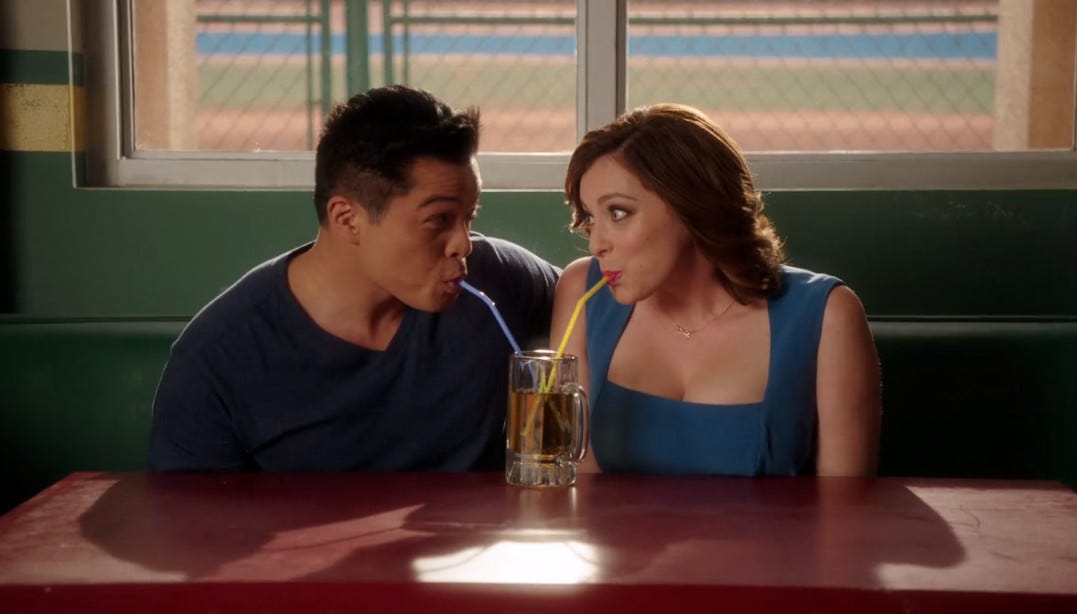
The First Time
Who moves from New York City to a small town in California for a man she dated briefly at summer camp? Who discards a career, an apartment, an entire life — for Josh Chan, who is, let’s be frank, neither extraordinarily interesting nor obviously worth the sacrifice? Why is she so obsessed? Why does she keep making choices that are so transparently, almost comically, self-destructive?
I watched the first two released seasons with a kind of detached bewilderment. I could appreciate the music. I could see that it was clever. But Rebecca Bunch was a mystery to me. A cautionary tale about someone else’s particular brand of dysfunction.
I didn’t know I had a personality disorder then. Rebecca didn’t yet have her new diagnosis either. We were both, in our respective ways, completely in the dark about ourselves.
Then I had my breakdown in Montreal. I came back to Korea feeling like a loser — that specific, hollowing kind of shame that comes not just from failing but from failing publicly, from returning somewhere you left with ambition and arriving back with nothing that looks like what you promised. I sat with that for a long time.
And then I watched the rest of the show.
The Second Time
I couldn’t always finish episodes. There were scenes I had to pause and walk away from — not because they were badly written, but because they were too accurate. Watching Rebecca collapse and then feel ashamed of her collapse, watching her cycle through remorse and rationalisation and the particular cruelty she reserved for herself — I recognised something. I recognised it in my body before I recognised it in my mind.
I was going through my first real heartbreak then. And for the first time, I thought: I resemble her a little.

The way she tried to dehumanise the person who left her, in order to survive the leaving. The way she oscillated between I am the wronged party and I am the villain with very little stable ground between the two. The way love felt less like a feeling and more like a gravitational force — something that happened to her, something she had no reasonable hope of resisting.
That was the first time I allowed myself to wonder whether I might have BPD.
It took several more years and several consecutive rounds of therapy before I could actually say it out loud and mean it. I have BPD. Not as an explanation. Not as an excuse. Just as a fact about the architecture of my mind.
“I wanted to be a good person. Yes, it’s true. Be a good person — but better than who?”
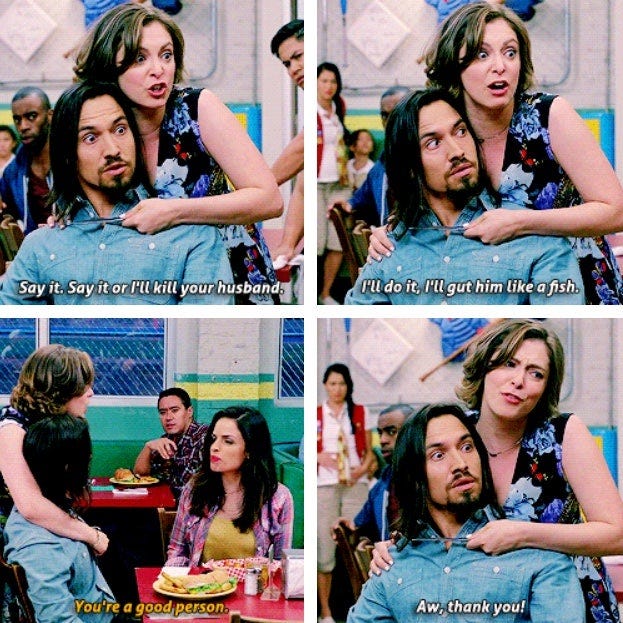
Here is what I genuinely believed, for a long time: that love would fix it.
Not fix it in a vague, romantic sense. I mean I had a specific, operational theory. That if I could find the right person — the right love — the illness would become irrelevant. The intensity that had caused so much damage would become a feature rather than a flaw. I would be understood in the way I needed to be understood, and the understanding would stabilise me, and I would finally become the good person I had always been trying to be.
She was my Josh.
And I mean that more literally than it might sound.
Rebecca Bunch moves from New York City to a small town in California — discards her career, her network, her entire built life — to be near someone she loves. I watched that and thought: who does that?
Then I did it.
I ditched my career. I left my network. I moved to her city — her hometown — because we had been long-distance and it was expensive and exhausting, and I told myself the practical reasons, the financial reasons, the sensible reasons. Accommodation costs. The logic of shared rent. The efficiency of proximity.
I told myself, very clearly and with complete conviction, that I was not moving for her. I was moving for myself. For a better future. For practical reasons. For growth. I ran the internal analysis and concluded: this is the right choice, and it happens to involve being near someone I love, which is simply a bonus.
I knew, even then, that I was making excuses. Not consciously — that’s the part that’s hardest to explain to people who haven’t experienced it. The knowing and the not-knowing existed simultaneously. I could sense the shape of the real reason underneath all the rational ones, and I chose, very deliberately, not to look directly at it.
I see it clearly now. I couldn’t afford to see it then.
But underneath all of it, underneath every reasonable justification, was the same cathedral Rebecca builds and I build and every person with BPD builds in the dark: if I can just get there, to the right place, with the right person, everything will finally work.
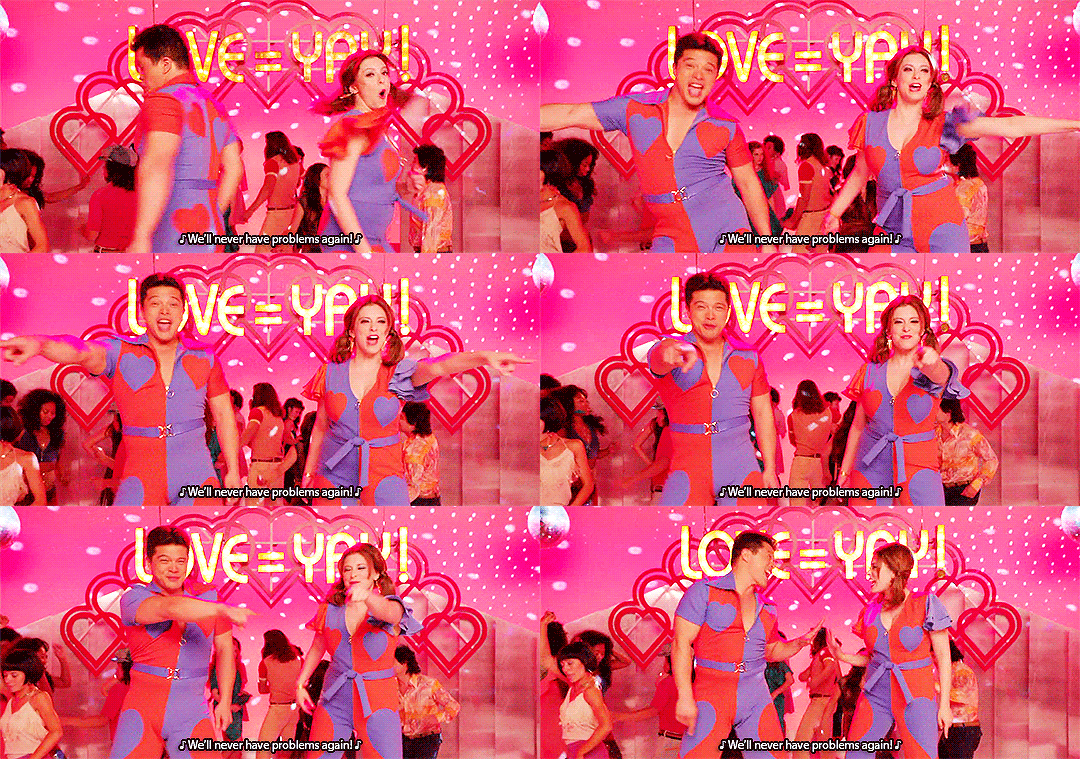
My relationship with my parents was never simple either. Devoted, controlling, impossible to rest inside — the kind of love that means well and lands hard. Living under their roof was never home. It was just a house, a place I returned to and endured. I thought living with her would solve it. The burnout, the helplessness, the financial pressure, the longing to finally feel stable and free. I thought love in the right location would do what nothing else had managed.
I would be happy. I would be fixed.
I know how that sounds. I know that from the outside, the logic doesn’t hold. But when you have BPD and you fall in love — really fall, the kind that doesn’t feel like a choice, the kind that can only be described in a verb form of crush — the certainty is total. I believed we were destined. Not in the abstract way that people say such things when they’re happy. In the bone-level, cosmically confirmed way. Our meeting felt arranged. Our connection felt singular. I had never loved anyone like this before, which I took as evidence that this was different, that I was different, that the patterns that had undone previous relationships simply wouldn’t apply here.
I wanted to be a good person. I was trying so hard to be the ‘right’ person.
But the goodness was never entirely for its own sake, was it? It was relational. It was contingent. It was for her, which meant it was also, underneath everything, a performance of worthiness. A constant, exhausting audition for the role of someone who deserved to be loved and not left.
The show has a song called Put Yourself First — ostensibly about the male gaze, about women performing self-improvement for an audience of men while calling it self-care. It’s one of the show’s sharpest jokes. But watching it now, I hear something else in it entirely.
I always put myself first — for us. That was how I understood sacrifice: not as self-erasure, but as investment. I was willing to give up the career, the city, the network, the version of myself I had built in other places — because the relationship was the thing I had decided mattered most. I told myself this was love. I told myself this was strength, not fear. The willingness to burn everything down and hand her the warmth.
What I couldn’t see then was that you cannot sustain a relationship on that kind of sacrifice. It curdles. The person receiving it starts to feel the weight of what it cost you, even if you never say it aloud. And the person giving it starts to lose the thread of who they are outside of the giving.
“I’m just a girl in love. I can’t be held responsible for my actions.”
The show performs this number with such precise satirical glee that it's almost painful to watch. Because the alibi is real. Not calculated — that's important. When you're in the grip of a BPD episode, when the emotional intensity has eclipsed everything else, the logic actually holds. This is love. Love is overwhelming by definition. Therefore, my behaviour is simply what love looks like.
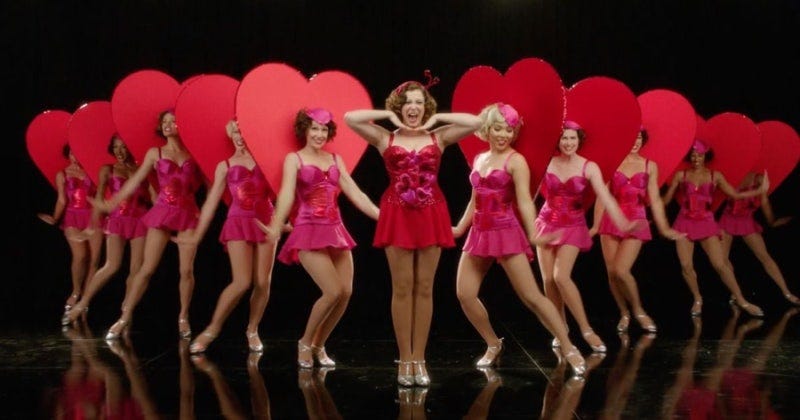
I was adorably obsessed. I was just in love.
The harm I caused, the volatility, the need for constant reassurance, the arguments that arrived from nowhere — those weren’t symptoms of an illness that required treatment. They were evidence of how much I cared.
This is one of the most dangerous stories we tell ourselves. Not because it excuses the behaviour — it doesn’t, and the show is very clear on that — but because it delays the moment of reckoning. The moment where you look at the pattern and admit: this isn’t love making me irrational. This is the illness that I haven’t yet learned to manage, causing harm to the person I love most.
“You ruined everything, you stupid bitch.”
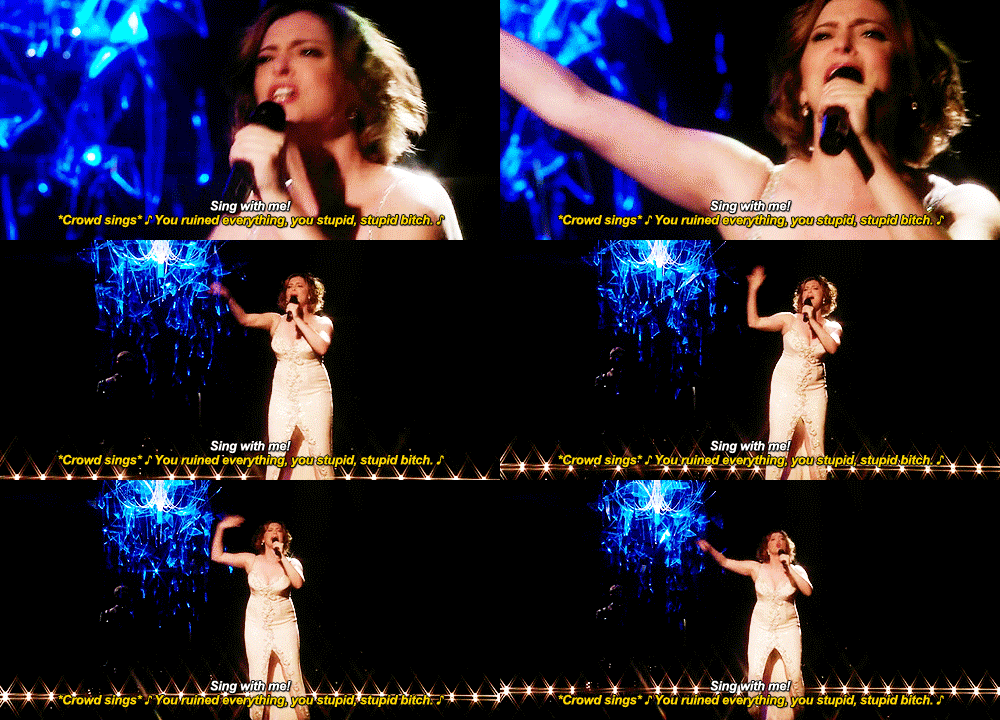
Rebecca sings this to herself. At herself. In a mirror.
I did not have words for it the first time I heard it. I had to sit in the dark for a while afterwards.
Because this is the voice. The one that speaks in the small hours, after everything has gone wrong. After the illness has done what the illness does and you are left in the wreckage of your own making, trying to understand how someone who wanted so badly to be good could have caused this much damage. The voice doesn’t argue. It doesn’t reason. It simply states, with absolute conviction: you ruined everything.
The show has another lyric that lands differently — quieter, nastier, more precise. It goes: uprooted everything and said you’d made a switch, but you’re still a poopy little slut who lives in a dream and doesn’t know how to love.
I came to a Buddhist temple in the mountains of Korea. I uprooted everything. I said I’d made a switch.
Some mornings I believe it. Some mornings the bell rings at 4 am and I get up and meditate and I feel genuinely different — lighter, more present, less haunted by the particular ghosts I carried here with me.
Other mornings I wonder whether I am simply the same person, performing transformation somewhere more scenic.
That question doesn’t have an answer yet. But I think asking it honestly — without flinching, without immediately reassuring myself — might be the closest thing to actual change I’ve managed so far.
What I’ve been slowly learning, here in the temple with the bells and the prostrations and the cold mornings, is that the you ruined everything voice is not honesty. It feels like honesty. It has the tone and cadence of a reckoning. But it is actually just another face of the illness — self-destruction wearing the costume of self-awareness.
Real accountability sounds different. It doesn’t obliterate. It says: I caused harm, and I need to understand why, and I need to do differently.
The difference between those two things is not small. I am still learning to hear it.
Rebecca’s defence, in the show, is almost comic in its specificity: I give annually to UNICEF. As if charitable giving cancels out the wreckage. As if one column of goodness balances the other. It’s played for a dark laugh, and I laughed — and then I sat very still, because I have made that exact accounting in my own head more times than I can count.
The difference is that Rebecca’s reckoning comes from herself. Mine came from outside.
On our last phone call, she told me: now that you know that you’re not a good person.
I’ve turned that sentence over every night since. It doesn’t leave. It has lodged somewhere below the ribcage and rings there in the dark, and I don’t know yet whether it is a wound or a truth or both at once. Probably both. The things that stay with us usually are.
What I do know is that it’s not the whole sentence. Now that you know implies there is a before and an after. A version of me that didn’t know, and a version that does. And what I do with the knowing — that part hasn’t been written yet.
“Yes, Josh completes me. But how can that be when there’s no me left to complete?”
This is the line I paused for. Rewound. Played three times.
Because the particular cruelty of BPD — the thing that makes love so devastating, so inevitably weighted — is that we don’t just fall in love. We dissolve into it. Over the course of three years, I assembled a version of myself in the context of being loved by her. The best version, I think. The one I most wanted to be. And when it ended, I didn’t only lose her. I lost the self that had been built inside that love.
Rebecca’s question is the right one, and it has no comfortable answer. If you’ve spent the relationship outsourcing your identity to another person, then losing them isn’t only heartbreak. It’s a kind of structural collapse. You’re not mourning a relationship. You’re mourning the architecture of yourself.
Which is, I think, why I came here. Not primarily for Buddhism, though I’m becoming something adjacent to a believer. But because I needed to find out whether there was a self here — in the quiet, in the routine, in the absence of her — that could exist without being completed by anyone.
The jury is still out. But there are mornings when I think the answer might be yes.
“How could I still not know myself after all that I’ve been through?”
I didn’t understand Rebecca Bunch the first time I watched this show because I hadn’t yet been through enough to recognise her. Or so I thought.
The truth is more uncomfortable. I didn’t recognise her because I wasn’t ready to. Because recognising her would have meant recognising myself, and I wasn’t ready to look at what that meant. I was still in the part of the story where the behaviour is inexplicable, and the person is a mystery, allowing you to sit at a comfortable distance and wonder why someone would make those choices.
Then Montreal happened. Then the first heartbreak. Then the therapy. Then her. Then this.
And now I rewatch it from a Buddhist temple in Korea at half past eight in the morning, and I understand every single choice Rebecca makes. I don’t agree with all of them. But I understand them. The logic is not mysterious to me anymore. It is legible. It is, on the worst days, familiar.
The show’s answer to Rebecca’s final question is honest in a way I admire: she hasn’t been through too little. She’s been moving in the wrong direction. Horizontally, from crisis to crisis, rather than downward. Rather than in. Staying still long enough for the sediment to settle.
That is what this place is doing to me. The stillness is terrifying for a BPD brain — stillness means being alone with yourself, without anyone to reflect yourself back to you. But I’m finding things in it. Small, quiet things. Things that seem to belong to me and not to anyone else.
I don’t know who I am yet. But I am starting to suspect I exist.
That feels, for now, like enough.
A question I haven’t stopped asking
People call BPD an illness. I understand why — it’s a clinical diagnosis, it has a treatment framework, it sits in the same categories as other things we call illnesses. But there’s something about the word that has never quite fit, and I’ve been trying to work out why.
Depression, people say, is like a cold. It can happen to anyone. It arrives, it disrupts, it can be treated, it can lift. You take the pills and wait and eventually something shifts. The illness was visiting. The illness is not you.
But personality disorder? You are not a person who has it. You are it. It is not a weather pattern passing through you — it is the climate. The way I attach, the way I love, the way I fear abandonment, the way I can go from completely fine to completely undone in the span of a single misread text — these are not symptoms I experience. They are the way my mind works. They are me.
So what does fixing it mean? How do you fix yourself without ceasing to be yourself? How do you become a healthy person when you have never once felt like one — when you know how to perform health, how to wear it convincingly enough that most people can’t tell, but you have no idea what it actually feels like from the inside?
Go and search for Cluster B personality disorders right now. I’ll wait.
The comments you’ll find, reliably, across forums and Reddit threads and advice columns, are some variation of: run away. People with personality disorders are dangerous. They will ruin your life.
I have read those comments about myself. About people like me. I have sat with the knowledge that if someone I loved searched for information about my diagnosis, this is what they would find. A warning. A list of red flags. Instructions to leave.
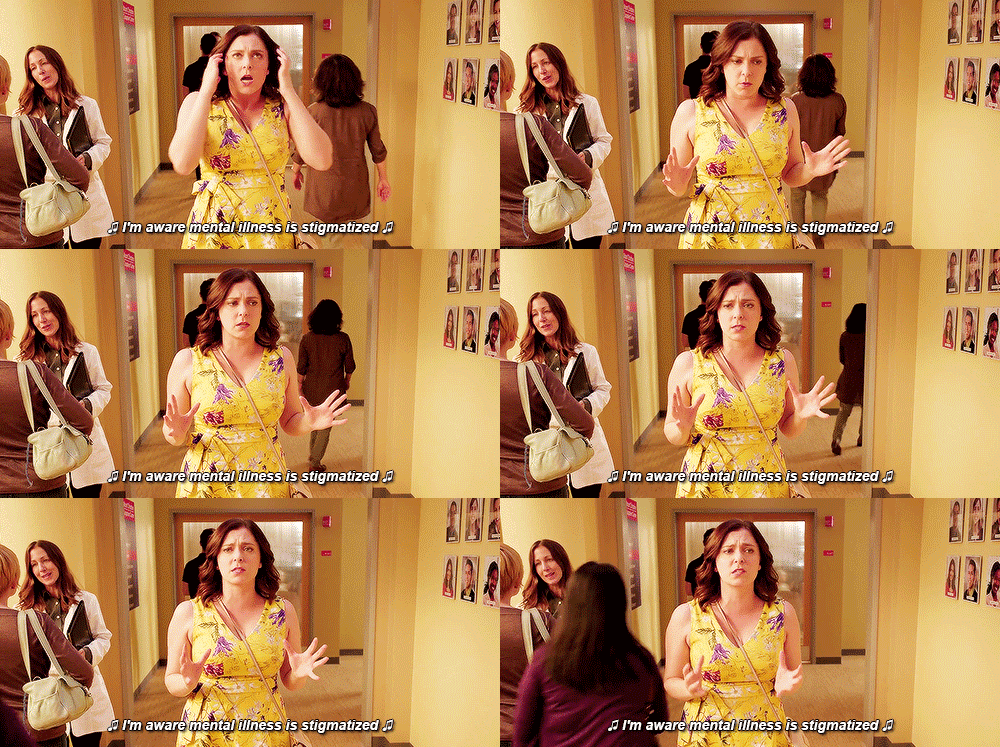
And here is what makes it so suffocating: I knew about my BPD. I tried, genuinely tried, not to act like one. I was in therapy. I was tracking my patterns. I wanted so badly to be the exception — the one who had the diagnosis but managed it, who loved carefully enough that the illness stayed contained, who could be close to someone without eventually becoming too much.
She left because I was too much anyway. The physical illness I went through that year stripped away every coping mechanism I had, and the mental illness that had been quietly managed beneath the surface came flooding up, and I was too much, and she left.
I understand why. I do. Understanding it doesn’t make it easier to live with.
What I can’t resolve is this: I don’t want to hide my diagnosis. Honesty feels like the only dignified way to move through the world. But honesty about BPD hands people a pair of coloured lenses before they’ve even had a chance to see you clearly. The label precedes you. The internet’s verdict arrives before you do.
I don’t know whether I can be loved. Not in the sustained, non-catastrophic way I want to be loved.
I don’t know whether I can be fixed. I’m not even sure that’s the right question.
Rebecca doesn’t get fixed either. The show doesn’t offer that. What she gets, slowly and imperfectly, is self-knowledge. And the quiet suggestion — tentative, unguaranteed — that self-knowledge might be enough of a foundation to build something on. Not what you originally planned. Something else. Something that is actually yours.
Crazy Ex-Girlfriend doesn't end with Rebecca healed or partnered or resolved. It ends with her discovering what she loves doing — not who she loves, but what. It's a quieter ending than the show's premise promises, and I think that's entirely the point.
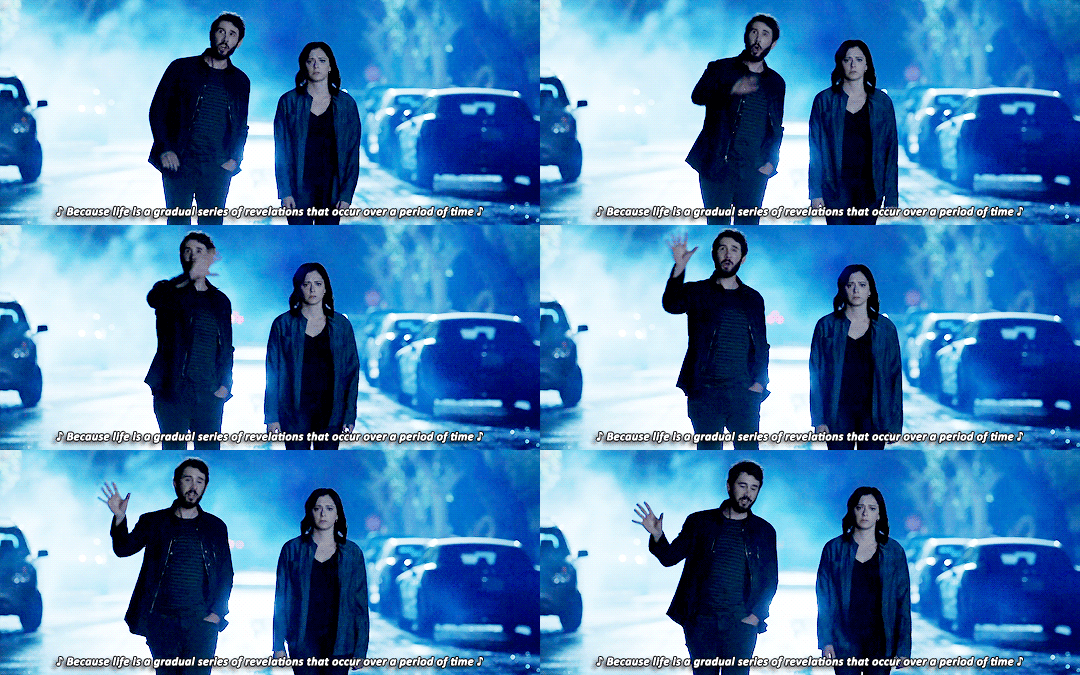
I’m not at an ending. I’m somewhere in the complicated middle. But I watched this show again this week and felt, for a sustained period of time, genuinely seen — which is a remarkable thing for a television programme to do, and perhaps the most honest review I can offer.
If you have BPD, or suspect you might, or simply love with an intensity that has sometimes frightened you: watch it. Not because it will fix anything. But because there is something quietly radical about a story that doesn’t pathologise you, doesn’t make you the villain, and trusts you to sit with the full complexity of what you are.
We are a lot. But we are not nothing.
Emotionally yours (still figuring out which ones),
Suinny
From a Buddhist temple, where the mornings are cold and the questions are slow
P.S. — The show was created by Rachel Bloom, who stars in it and wrote most of the songs. The BPD diagnosis Rebecca receives in the final season was apparently years in the making, narratively. It shows. The care with which the writers handled it shows. Watch all four seasons.
P.P.S. — If this resonated and you’ve been carrying a diagnosis, or a suspicion of one, I’m here. Reply to this letter. I read every single one.